A few months ago we acquired Buddy from a lovely family after our Blue Heeler was killed. His prior family said they couldn’t keep him (for a number of reasons), said they hadn’t even named him but I suspect they were fibbing; a little white lie to ease our grief.
Right away our family asked what we were going to name this little fellow. Without thinking (in my typical weird, off the cuff manner) I blurted out, “He told me his name is Patrick, but that we could call him Buddy.” The grand-kids believed me, excited that I could communicate with dogs. The children mumbled something about having me committed. I just smiled and thought, at least I don’t talk to shoes.
My wife’s new pink slippers
have gay pom-poms.
There is not a spot or a stain
on their satin toes or their sides.
All night they lie together
under her bed’s edge.
Shivering I catch sight of them
and smile, in the morning.
Later I watch them
descending the stair,
hurrying through the doors
and round the table,
moving stiffly
with a shake of their gay pom-poms!
And I talk to them
in my secret mind
out of pure happiness.
We later found out that Buddy’s name was ‘Gus’. My husband couldn’t wait to share that bit of information. I said something like, “Aww, I knew they sacrificed their sweet puppy out of pure kindness.” He of course really wanted to make the point that the dog had NOT told me his name was Patrick. At that point I had to be honest…
“Hmm… Well, he didn’t really say his name was Patrick.” I admitted.
“I KNEW IT!” Husband gloated.
“What he actually said was that he was born Patrick Gustav, but he prefers to be called Buddy.”
The husband politely conceded and took Buddy out to find a new stick.
I was relieved that the issue had been settled once and for all until Buddy ran back in to tell me something; a disturbing bit of gossip actually. He said after the lights are out and the house is quiet that my Reeboks snicker and mock me, they laugh at the way I run!
The shoes, of course have the right to their opinion and I (of course) have the right to stomp around in altered footwear.
I find they fit much better minus the tongue. 😉
“The Thinker” was published in Williams’s book, Sour Grapes: a book of poems (The Four Seas Company, 1921).
Don’t let poetry die from neglect or sit gathering dust until next April.
Side note: This is Linda’s audiobook debut. Imagine a British actress narrating southern poetry, better yet listen. I, myself was pleasantly surprised.
A tree’s leaves may be ever so good,
So may its bar, so may its wood;
But unless you put the right thing to its root
It never will show much flower or fruit.
But I may be one who does not care
Ever to have tree bloom or bear.
Leaves for smooth and bark for rough,
Leaves and bark may be tree enough.
Some giant trees have bloom so small
They might as well have none at all.
Late in life I have come on fern.
Now lichens are due to have their turn.
I bade men tell me which in brief,
Which is fairer, flower or leaf.
They did not have the wit to say,
Leaves by night and flowers by day.
Leaves and bar, leaves and bark,
To lean against and hear in the dark.
Petals I may have once pursued.
Leaves are all my darker mood.
Adding to our poets of the future, laureates in waiting, aka not yet notorious composers today I present to you Typhanie Tijerina- Hill. No we are not related as far as I know but if she were to win a Pulitzer or become a future Poet Laureate that might change.
Typhanie is currently a student at the University of Texas at Tyler studying Chinese, Literature and History.
Prior to UT she attended Trinity Valley Community College where she studied theater, literature and history.
Typhanie is also a wife and a mother. Anyone who has juggled such roles knows the hardships and the rewards. It takes an iron will and an artist’s heart and that is a kick- *ss combination.
I chose A Willow Among the Maple because (for me) it reflects humility and strength… Coming to terms with who we are and accepting our limitations without conceding defeat.
A Willow Among the Maple
By Typhanie Tijerina-Hill
I am a willow among the Maple
I weep while they pour out syrup so sweet
I am droopy and they are strong
I fight for survival while they grow with ease
My roots are planted deep
But are small compared to their large core
They hover over me mocking my fragile limbs
I know I will never be as big as the maple
But I don’t have to be
***
I really, really liked this poem because it left me nodding my head and thinking…
Sometimes it’s like reaching for the stars on a cloudy night. But if we keep reaching, groping into the unseen – maybe one night the clouds will pass and maybe, just maybe we will find a star in our hand. Perhaps not the biggest or the brightest star – but it will be the best star because this one will have our name on it.
This week I’m not featuring renowned poets.
This week let’s look at future poets or should I say not yet notorious composers.
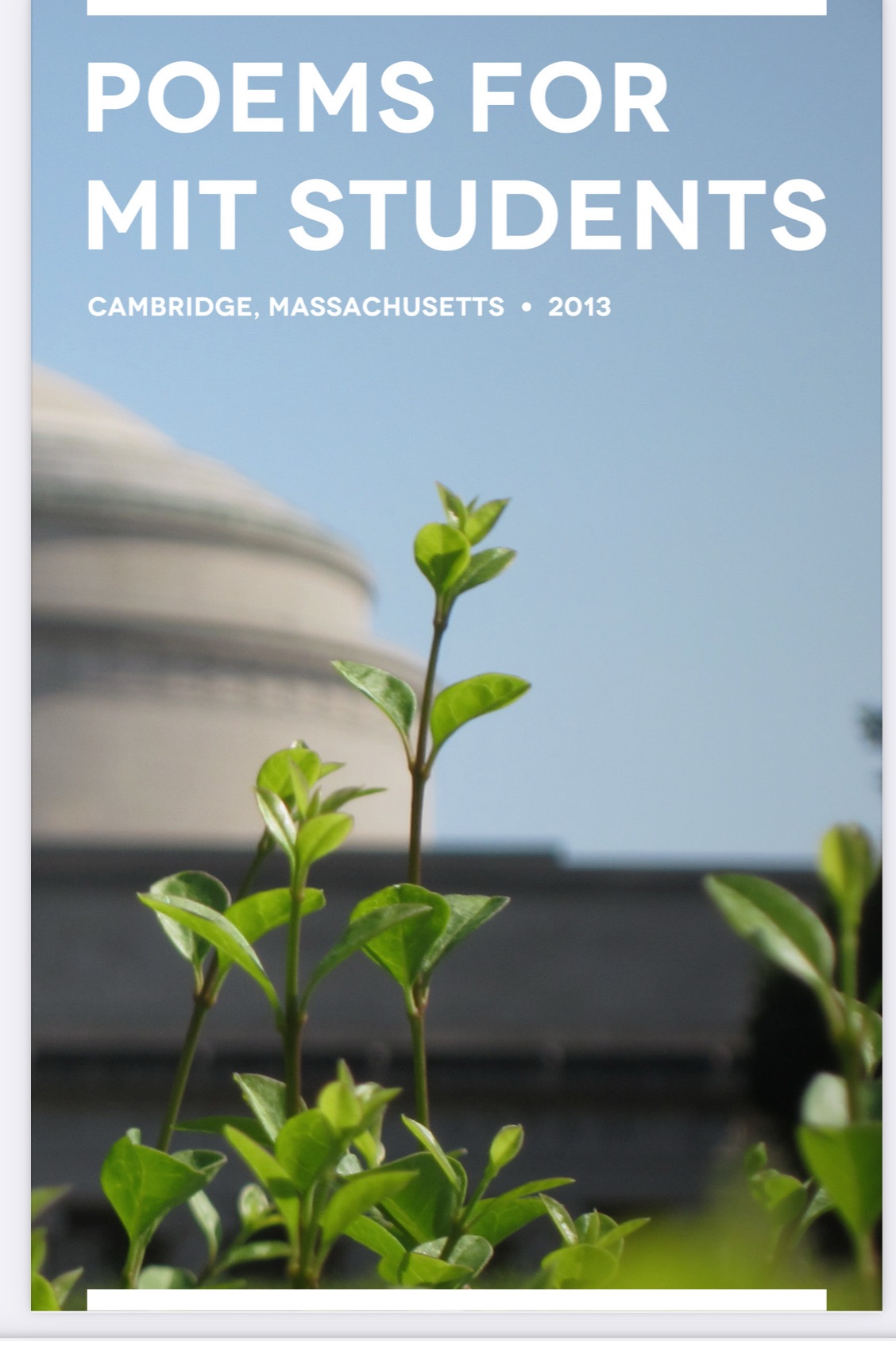
The following poem was taken from
Poems for MIT Students.
A simple cover for a deep book.
It was written [and I quote] “by MIT students, for MIT students.”
Of the 20+ poems in this little chapbook I chose Almost by Julia Kimmerly.
Ahh you thought MIT was a boring technical institute with some weird shorthand logo that has occult meanings. Maybe that was my line of thinking? No, all I can think of is the Bee Gees so y’all go ahead and read while I sing.
And the lights alllll weennnt out in Massachusetts…
Julia Kimmerly / 2013
it’s been a while since the smile of a pen has styled my page,
ages since mental meandering, penned pondering, wistful wandering
wondering about mysteries, histories, blistering bliss stories
of sinister misters, kissed-hers, twisted listening and
tea: a small plea from me to indulge.
today is a break from the intensity.
it makes a bulge in the tense immensity of stress,
incensed duress.
Dad’s mom’s locket rests in my palm,
her psalms next to his curbed proverbs:
once begun half done
measure twice, cut once
a stitch in time saves nine
but what about when the second half is baffling,
twice doesn’t suffice,
and the stitches come undone
like poorly hitched horses looking for fodder?
what about:
everything in moderation
variety is the spice of life
everything is relative—
relative to what?
it’s all the same insane struggle,
trouble bubbling over from one night to the next.
fight the biting light, the tightening sight as eyelids sigh
sleep is nigh
the group droops with equations left unsolved
greek letters in an unresolved war
equality separating the horror.
symbols swapping sides and constants barring pi’s.
Intensity Has a Taste For Pain.
this feast of information has ceased to be fun.
the yearning of learning gone,
no longer appealing.
the feeling of prolonged gratification
empty.
the anticipation not
tempting.
teachers hold the treat just out of reach,
each time bringing me forward
toward the future, it’s
badder, better, bigger, baller, butter from the stick
but if I don’t get out of this mean fiendish routine—
color outside the confining outline—
i won’t survive.
my thriving creativity of young,
now stifled insensitively,
clung to by what grip I have left.
i want to rip away from the
numerical masochism
hysterical workaholism
compensation for lack of sensation.
i have forgotten how to live,
rotten, now oblivious to what reality does,
sacrificing who I am now, or was, for who I could be.
but that to-be she is only one possible me
a successful breast full of delicious accomplishments.
yes, enticing time now is dimes and cents to my future dollars
a smaller price to pay for a greater later
a relentless satyr of ambition
searing volition to steer myself straight to the top.
but I don’t want to wait and be
a fated one-sided, dull-minded, blind signer
i want to be alive.
strive for more than better letters and wonder numbers
get out of this slumber and
find time for stars and clouds and dimension counting
Mars and How’s and existential doubting
the so-bad-its-good idea talks
the late-night, fate-type of walks
more coffee shops and railroad stops
beer stein hops and sly eaves drops
i want to tout the now and
scout the crowd for smiles and Guastavino tiled lies
(he knows woe woven into faulted vaults).
i want to drive and be driven.
And given the chance, yes i will.
but until the game is won, tassel hassled and the famous cap flung,
i have to persevere
buckle down for my career
gear up for my dear job.
study, read, feed my mind until it wants to be fed.
beg, plead, lead my mind until it wants to be led.
heed my mind until it is ahead, not overrun.
until all is said and done.
Just in case I missed telling one person in the far reaches of Idonwannaherit (which is my husband’s country of origin) April is National Poetry month.
And guess what?! I was informed this morning that I have been nominated for the Pulitzer Prize Award. I’m thinking OMG! Am I so special they called me early? Turns out it was an April Fool’s joke. Damn you cruel jokester and may the winning of Publishers Clearing House Sweepstakes forever be just out of your reach.
With the fool’s business out of the way I’d like to talk about Plath.
Not because of her life’s work. In all honesty it is/was her chronic obsession with death that compels me.
In reading Lady Lazarus with or without knowing Plath’s history I could have imagined a poet scribbling thoughts that were just that- thoughts.
But the [reportedly] last two pieces she wrote and the two small children she left behind. I became strangely fanatical.
photo by Rollie McKenna
I tried hard not to judge her as a person and to focus only on the writing but I fell short. History, rumor and suspicion clouded my judgment.
In Balloons all I could see was her surveying her child at play – a child she would [knowingly?] soon leave motherless.
And in Edge… it would have been eerily sufficient without knowing Sylvia Plath Hughes had made for herself a gas chamber.
In doing so she had eliminated the need for an executioner so I became her judge, juror and examiner.
It wasn’t enough for me to obsess over the tragedy I insisted my husband partake of the mind numbing fixation.
His first response was, “You know I don’t read poetry. I don’t read anything that doesn’t have live game, a stock symbol or a machining program written on it.”
To that I handed him a beer and smiled, “Okay. I’ll read it to you and you tell me what you think.”
He agreed, though once I finished reading Edge aloud he held out his hand and ordered me to give it to him.
I graciously obliged.
Here it is in its entirety. Our discussion will follow.
Edge by Sylvia Plath 1963
The woman is perfected.
Her dead
Body wears the smile of accomplishment,
The illusion of a Greek necessity
Flows in the scrolls of her toga,
Her bare
Feet seem to be saying:
We have come so far, it is over.
Each dead child coiled, a white serpent,
One at each little
Pitcher of milk, now empty.
She has folded
Them back into her body as petals
Of a rose close when the garden
Stiffens and odors bleed
From the sweet, deep throats of the night flower.
The moon has nothing to be sad about,
Staring from her hood of bone.
She is used to this sort of thing.
Her blacks crackle and drag.
When he finally looked up I asked, “So what do you think?”
He took a long drink and shrugged, “She obviously wanted to be dead and she’s happy about it.”
“Yes, yes. Go on.” I urged, “What about the scrolls of her toga?”
“Sounds like the Clinton – Lewinsky thing. You know with the stained dress.”
I laughed and he continued. “Here where she says ‘it is over’ means just that – she’s finished.”
“What about the lines ‘each dead child coiled, a white serpent, one at each little pitcher of milk, now empty’ what do you think about that?”
“The Exodus? It sounds like the first Passover and the last plague in Egypt to me.” He looked back at the page in front of him and read,
“She has folded them back into her body as petals of a rose close when the garden stiffens and odors bleed from the sweet, deep throats of the night flower.”
He shook his head and returned the poem, “Did she plan to kill the kids and take them with her? I guess it doesn’t matter- It was fifty years ago, she was mentally ill and she’s glad she’s dead.”
“What about ‘the moon has nothing to be sad about, staring from her hood of bone. She is used to this sort of thing. Her blacks crackle and drag’ – what are your thoughts on that?” I asked, watching as he became more uncomfortable.
“It sounds like craziness. She was obviously mentally ill. Did you say she stuck her head in an oven?”
I nodded.
“Was it butane or natural gas?”
“I have no idea. Why would that matter?”
“Well one falls and the other rises – natural gas rises. Did she live in town or in the country? If she lived in town it was probably natural gas.”
“She lived in London, a town residence once occupied by Yeats.”
“Hell, it might have been coal fuel.” He paused as if it took added effort to ask the next question. “Did she kill her kids too?”
“No.” I answered.
His face relaxed a bit until I added, “The youngest, a boy named Nicholas hung himself in 2009. The daughter who was less than three years old when it happened went on to become a painter and poet.”
“Dammit! How’s the girl doing?”
“I don’t personally know her but she was still alive the last I heard.”
“Poor thing. Damaged people leave a lot of garbage in their wake. Hopefully she’s not too messed up.”
With that he bent and twisted the empty can indicating the discussion was over.
I mumbled a thank you, delighted I had snagged him into reading a poem yet a little ashamed that I had disturbed him with the past of Sylvia Plath.
Next week maybe I will entice him with a new poet, a living poet.
I will probably [silently] take a closer look at the works of Ted and Frieda Hughes, dissecting their psyches and torturing myself in the aftermath of Sylvia Plath.




 The Real Janna Hill in