A Poem & A Picture (Day 3)

Caterpillars

By Brod Bagert

They came like dewdrops overnight
Eating every plant in sight,
Those nasty worms with legs that crawl
So creepy up the garden wall,
Green prickly fuzz to hurt and sting
Each unsuspecting living thing.
How I hate them! Oh, you know
I’d love to squish them with my toe.
But then I see past their disguise,
Someday they’ll all be butterflies.

___________________________________________________________________________________

Okay I know this caterpillar will turn into a  moth. A Polyphemus moth to be exact but shhh she thinks she’s a butterfly.

Not Yet Notorious Composers

This week I’m not featuring renowned poets.
This week let’s look at future poets or should I say not yet notorious composers.
The following poem was taken from

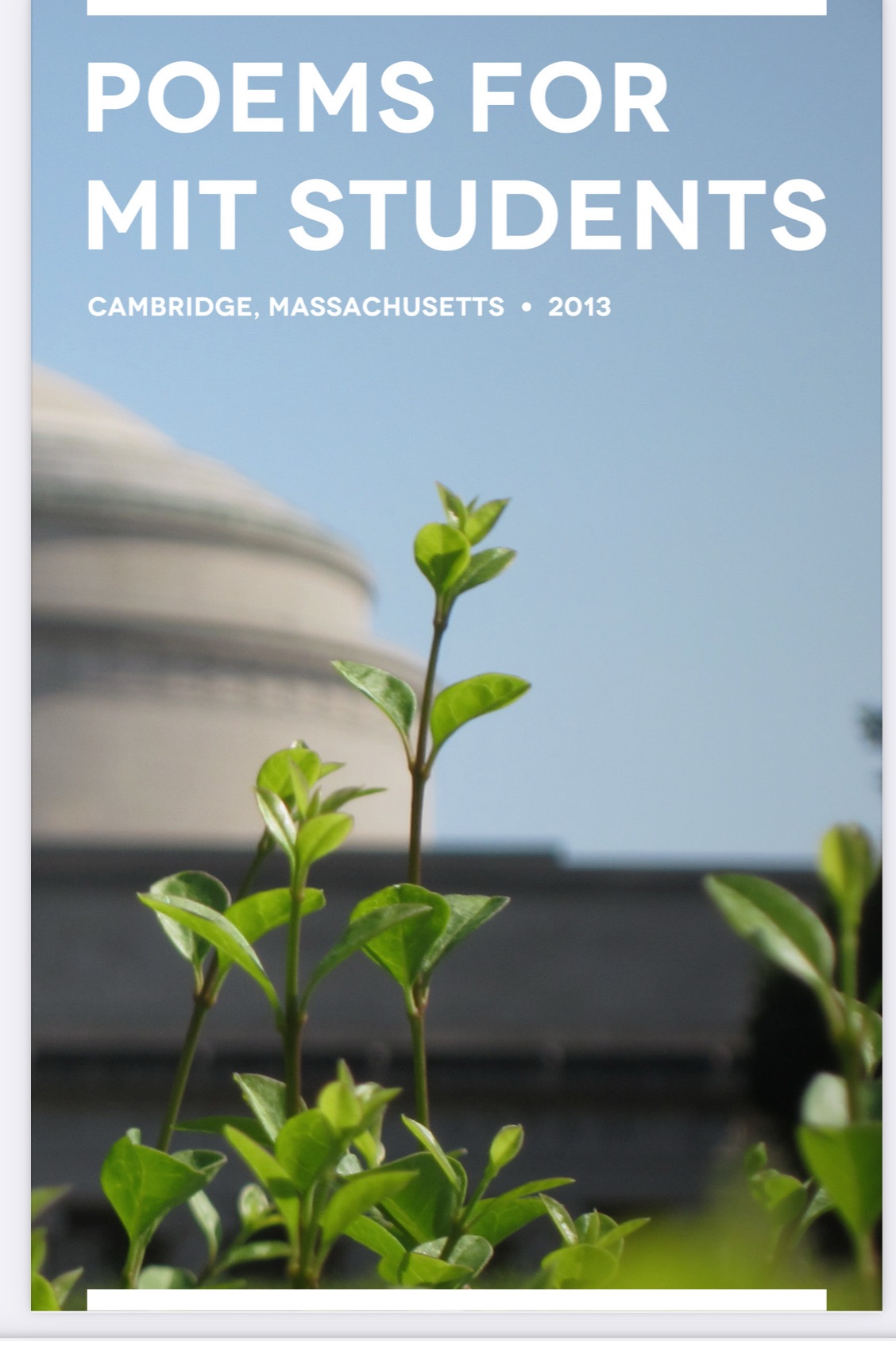
Poems for MIT Students.

A simple cover for a deep book.

It was written [and I quote] “by MIT students, for MIT students.”

Of the 20+ poems in this little chapbook I chose Almost by Julia Kimmerly.

(I hope 🤞🏼 this links to the free PDF file.)


MIT_logo_black_red


Ahh you thought MIT was a boring technical institute with some weird shorthand logo that has occult meanings.  Maybe that was my line of  thinking? No, all I can think of  is the Bee Gees so y’all go ahead and read while I sing. 

And the lights alllll weennnt out in Massachusetts…


Julia Kimmerly / 2013

it’s been a while since the smile of a pen has styled my page,
ages since mental meandering, penned pondering, wistful wandering
wondering about mysteries, histories, blistering bliss stories
of sinister misters, kissed-hers, twisted listening and
tea: a small plea from me to indulge.
today is a break from the intensity.
it makes a bulge in the tense immensity of stress,
incensed duress.
Dad’s mom’s locket rests in my palm,
her psalms next to his curbed proverbs:
once begun half done
measure twice, cut once
a stitch in time saves nine
but what about when the second half is baffling,
twice doesn’t suffice,
and the stitches come undone
like poorly hitched horses looking for fodder?
what about:
everything in moderation
variety is the spice of life
everything is relative—
relative to what?
it’s all the same insane struggle,
trouble bubbling over from one night to the next.
fight the biting light, the tightening sight as eyelids sigh
sleep is nigh
the group droops with equations left unsolved
greek letters in an unresolved war
equality separating the horror.
symbols swapping sides and constants barring pi’s.
Intensity Has a Taste For Pain.
this feast of information has ceased to be fun.
the yearning of learning gone,
no longer appealing.
the feeling of prolonged gratification
empty.
the anticipation not
tempting.

teachers hold the treat just out of reach,
each time bringing me forward
toward the future, it’s
badder, better, bigger, baller, butter from the stick
but if I don’t get out of this mean fiendish routine—
color outside the confining outline—
i won’t survive.
my thriving creativity of young,
now stifled insensitively,
clung to by what grip I have left.
i want to rip away from the
numerical masochism
hysterical workaholism
compensation for lack of sensation.
i have forgotten how to live,
rotten, now oblivious to what reality does,
sacrificing who I am now, or was, for who I could be.
but that to-be she is only one possible me
a successful breast full of delicious accomplishments.
yes, enticing time now is dimes and cents to my future dollars
a smaller price to pay for a greater later
a relentless satyr of ambition
searing volition to steer myself straight to the top.
but I don’t want to wait and be
a fated one-sided, dull-minded, blind signer
i want to be alive.
strive for more than better letters and wonder numbers
get out of this slumber and
find time for stars and clouds and dimension counting
Mars and How’s and existential doubting
the so-bad-its-good idea talks
the late-night, fate-type of walks
more coffee shops and railroad stops
beer stein hops and sly eaves drops
i want to tout the now and
scout the crowd for smiles and Guastavino tiled lies
(he knows woe woven into faulted vaults).
i want to drive and be driven.
And given the chance, yes i will.
but until the game is won, tassel hassled and the famous cap flung,
i have to persevere
buckle down for my career
gear up for my dear job.
study, read, feed my mind until it wants to be fed.
beg, plead, lead my mind until it wants to be led.
heed my mind until it is ahead, not overrun.
until all is said and done.

Mark Your Books (April is National Poetry Month)


IV+PPP BookmarkMark your calendars and your books because… [drum roll]

April is National Poetry Month!

Last years celebration was fun and I already have several hundred   in mind for this year. If you have one you’d like to share or see dissected let me know.

Dead or alive – no poet is off limits.

😉 🙂 😀


In the Aftermath of Plath

Just in case I missed telling one person in the far reaches of Idonwannaherit (which is my husband’s country of origin) April is National Poetry month.

And guess what?! I was informed this morning that I have been nominated for the Pulitzer Prize Award. I’m thinking OMG! Am I so special they called me early? Turns out it was an April Fool’s joke. Damn you cruel jokester and may the winning of Publishers Clearing House Sweepstakes forever be just out of your reach.

With the fool’s business out of the way I’d like to talk about Plath.

Not because of her life’s work. In all honesty it is/was her chronic obsession with death that compels me.

In reading Lady Lazarus with or without knowing Plath’s history I could have imagined a poet scribbling thoughts that were just that- thoughts.

But the [reportedly] last two pieces she wrote and the two small children she left behind. I became strangely fanatical.

photo by Rollie McKenna photo by Rollie McKenna

I tried hard not to judge her as a person and to focus only on the writing but I fell short. History, rumor and suspicion clouded my judgment.

When I read Nick and the Candlestick I imagined premeditated recklessness beyond her own ending.

In Balloons all I could see was her surveying her child at play – a child she would [knowingly?] soon leave motherless.

And in Edge… it would have been eerily sufficient without knowing Sylvia Plath Hughes had made for herself a gas chamber.

In doing so she had eliminated the need for an executioner so I became her judge, juror and examiner.

It wasn’t enough for me to obsess over the tragedy I insisted my husband partake of the mind numbing fixation.

His first response was, “You know I don’t read poetry. I don’t read anything that doesn’t have live game, a stock symbol or a machining program written on it.”

To that I handed him a beer and smiled, “Okay. I’ll read it to you and you tell me what you think.”

He agreed, though once I finished reading Edge aloud he held out his hand and ordered me to give it to him.

I graciously obliged.

Here it is in its entirety. Our discussion will follow.

Edge by Sylvia Plath 1963

The woman is perfected.
Her dead

Body wears the smile of accomplishment,

The illusion of a Greek necessity

Flows in the scrolls of her toga,
Her bare

Feet seem to be saying:
We have come so far, it is over.

Each dead child coiled, a white serpent,
One at each little

Pitcher of milk, now empty.
She has folded

Them back into her body as petals
Of a rose close when the garden

Stiffens and odors bleed
From the sweet, deep throats of the night flower.

The moon has nothing to be sad about,
Staring from her hood of bone.

She is used to this sort of thing.
Her blacks crackle and drag.

When he finally looked up I asked, “So what do you think?”

He took a long drink and shrugged, “She obviously wanted to be dead and she’s happy about it.”

“Yes, yes. Go on.” I urged, “What about the scrolls of her toga?”

“Sounds like the Clinton – Lewinsky thing. You know with the stained dress.”


I laughed and he continued. “Here where she says ‘it is over’ means just that – she’s finished.”

“What about the lines ‘each dead child coiled, a white serpent, one at each little pitcher of milk, now empty’ what do you think about that?”

“The Exodus? It sounds like the first Passover and the last plague in Egypt to me.” He looked back at the page in front of him and read,

“She has folded them back into her body as petals of a rose close when the garden stiffens and odors bleed from the sweet, deep throats of the night flower.”

He shook his head and returned the poem, “Did she plan to kill the kids and take them with her? I guess it doesn’t matter- It was fifty years ago, she was mentally ill and she’s glad she’s dead.”

“What about ‘the moon has nothing to be sad about, staring from her hood of bone. She is used to this sort of thing. Her blacks crackle and drag’ – what are your thoughts on that?” I asked, watching as he became more uncomfortable.

“It sounds like craziness. She was obviously mentally ill. Did you say she stuck her head in an oven?”

I nodded.

“Was it butane or natural gas?”

“I have no idea. Why would that matter?”

“Well one falls and the other rises – natural gas rises. Did she live in town or in the country? If she lived in town it was probably natural gas.”

“She lived in London, a town residence once occupied by Yeats.”

“Hell, it might have been coal fuel.” He paused as if it took added effort to ask the next question. “Did she kill her kids too?”

“No.” I answered.

His face relaxed a bit until I added, “The youngest, a boy named Nicholas hung himself in 2009. The daughter who was less than three years old when it happened went on to become a painter and poet.”

“Dammit! How’s the girl doing?”

“I don’t personally know her but she was still alive the last I heard.”

“Poor thing. Damaged people leave a lot of garbage in their wake. Hopefully she’s not too messed up.”

With that he bent and twisted the empty can indicating the discussion was over.

I mumbled a thank you, delighted I had snagged him into reading a poem yet a little ashamed that I had disturbed him with the past of Sylvia Plath.

Next week maybe I will entice him with a new poet, a living poet.

I’ll choose something lighter, funnier and maybe drag out the frayed old book Where the Sidewalk Ends by Shel Silverstein. The kids and I always enjoyed that one.

I will probably [silently] take a closer look at the works of Ted and Frieda Hughes, dissecting their psyches and torturing myself in the aftermath of Sylvia Plath.

National Poetry Month & Expanding My Horizons

I went in search of a poet I knew nothing of [which is a ridiculously simple task for me] and pushed past my usual likes. To my surprise I liked this.

John Davidson was born at Barrhead, Renfrewshire, in 1857 and died by his own hand in 1909.


A BALLAD OF HELL


‘A letter from my love to-day!

Oh, unexpected, dear appeal!’

She struck a happy tear away,

And broke the crimson seal.

‘My love, there is no help on earth,

No help in heaven; the dead-man’s bell

Must toll our wedding; our first hearth

Must be the well-paved floor of hell.’

The colour died from out her face,

Her eyes like ghostly candles shone;

She cast dread looks about the place,

Then clenched her teeth and read right on.

‘I may not pass the prison door;

Here must I rot from day to day,

Unless I wed whom I abhor,

My cousin, Blanche of Valencay.

‘At midnight with my dagger keen,

I’ll take my life; it must be so.

Meet me in hell to-night, my queen,

For weal and woe.

‘ She laughed although her face was wan,

She girded on her golden belt,

She took her jewelled ivory fan,

And at her glowing missal knelt.

Then rose, ‘And am I mad?’ she said:

She broke her fan, her belt untied;

With leather girt herself instead,

And stuck a dagger at her side.

She waited, shuddering in her room,

Till sleep had fallen on all the house.

She never flinched; she faced her doom:

They two must sin to keep their vows.

Then out into the night she went,

And, stooping, crept by hedge and tree;

Her rose-bush flung a snare of scent,

And caught a happy memory.

She fell, and lay a minute’s space;

She tore the sward in her distress;

The dewy grass refreshed her face;

She rose and ran with lifted dress.

She started like a morn-caught ghost

Once when the moon came out and stood

To watch; the naked road she crossed,

And dived into the murmuring wood.

The branches snatched her streaming cloak;

A live thing shrieked; she made no stay!

She hurried to the trysting-oak—

Right well she knew the way.

Without a pause she bared her breast,

And drove her dagger home and fell,

And lay like one that takes her rest,

And died and wakened up in hell.

She bathed her spirit in the flame,

And near the centre took her post;

From all sides to her ears there came

The dreary anguish of the lost.

The devil started at her side,

Comely, and tall, and black as jet.

‘I am young Malespina’s bride;

Has he come hither yet?’

‘My poppet, welcome to your bed.’

‘Is Malespina here?’

‘Not he! To-morrow he must wed

His cousin Blanche, my dear!’

‘You lie, he died with me to-night.’

‘Not he! it was a plot’ … ‘You lie.’

‘My dear, I never lie outright.’

‘We died at midnight, he and I.’

The devil went. Without a groan

She, gathered up in one fierce prayer,

Took root in hell’s midst all alone,

And waited for him there.

She dared to make herself at home

Amidst the wail, the uneasy stir.

The blood-stained flame that filled the dome,

Scentless and silent, shrouded her.

How long she stayed I cannot tell;

But when she felt his perfidy,

She marched across the floor of hell;

And all the damned stood up to see.

The devil stopped her at the brink:

She shook him off; she cried, ‘Away!’

‘My dear, you have gone mad, I think.’

‘I was betrayed: I will not stay.’

Across the weltering deep she ran;

A stranger thing was never seen:

The damned stood silent to a man;

They saw the great gulf set between.

To her it seemed a meadow fair;

And flowers sprang up about her feet

She entered heaven; she climbed the stair

And knelt down at the mercy-seat.

Seraphs and saints with one great voice

Welcomed that soul that knew not fear.

Amazed to find it could rejoice,

Hell raised a hoarse, half-human cheer.


(2011-03-23). Modern British Poetry (Kindle Locations 796-809).  . Kindle Edition.