
Jalapeno

Virginia Creeper

Squirrel


We did it! We celebrated nearly every day in April with a poem. Let’s reach around and give ourselves a nice pat on the back.
The celebration for me wouldn’t be complete without inviting the husband to participate. Of course I wanted to pick up where we left off last year in the aftermath of Plath. We discussed Plath and the children but we never talked about the husband and father, Ted Hughes.


Before discussing the man’s poetry we had to discuss the man. 
In a Nutshell
Edward James Hughes was born August 17, 1930 and was affectionately referred to as Ted. He served in the Royal Air Force for two years as a ground wireless mechanic. He attended Pembroke College on an academic scholarship and studied Anthropology, Archaeology, Mythology and published a few poems while he was at it.
After graduating from Cambridge he co-founded a literary magazine. It was at the magazine’s launch party that he met Sylvia Plath. A few short months later they were married.
The couple returned to England in 1959 and their first child Freida was born the following year. Nicholas was born two years later in 1962.
In 1962 Hughes left Plath for a woman named Assia Gutmann Wevill. In 1963 (less than a year later) Plath committed suicide.
In March 1965 Assia gave birth to a daughter nicknamed Shura.
She reportedly aborted her first pregnancy by Hughes after the death of Sylvia Plath.
In March 1969 Assia Wevill gassed herself but [unlike Plath] she took the child with her.
In 1970 Hughes married Carol Orchard whom he remained with until his death in 1998.
He was appointed Poet Laureate of England in 1984 and held the post until he passed away on October 28, 1998 in Devonshire, England, from cancer.
Let’s Discuss…
“So what do you think about that?” I asked and waited with anticipation. I don’t know what I was expecting as I watched him tip his head with one eyebrow cocked but his response caught me off guard.
“All I can say is poor bastard.”
“We partially agree but why on earth would you pity him?” I sincerely tried not to show my annoyance but after 30 years of marriage that is pretty much impossible.
“Who do you want me to feel sorry for?” he laughed, “You expected me to feel sorry for the women didn’t you?”
“We don’t have to feel sorry for any of them.” I’m sure I was blushing as it occurred to me he knew what I was thinking before I did.
“So he was with the last wife for nearly thirty years – was she a poet?”
“Not that I know of.”
“Well there you go. That’s probably why they were able to stay married. That or he kept her away from gas stoves.”
“Is that all you have to offer on the life of Ted Hughes?”
“At least he wasn’t around to know his son hanged himself. Other than that, yep, that’s all I’ve got. Let me get a beer and we’ll discuss his poem.”
By Ted Hughes
A cool small evening shrunk to a dog bark and the clank of a bucket –
And you listening.
A spider’s web, tense for the dew’s touch.
A pail lifted, still and brimming – mirror
To tempt a first star to a tremor.
Cows are going home in the lane there, looping the hedges with their warm
wreaths of breath –
A dark river of blood, many boulders,
Balancing unspilled milk.
‘Moon!’ you cry suddenly, ‘Moon! Moon!’
The moon has stepped back like an artist gazing amazed at a work
That points at him amazed.
Let’s Discuss More…
“Well…?”
“According to the title I assume that was for his daughter.”
“I think that is safe to assume. So what is your interpretation of the poem?”
“Skunks, dogs, spiders and cows… it sounds like the man had been outside a time or two.”
“I’m sure at least twice.”
“But what is this thing with him and Plath about blood or bleeding and milk and moons?”
“They’re natural themes I suppose with blood and milk being the basic sustenance of life. What’s your take on it?”
“My take is basically I need another beer.”
“Okay. Give me a closing thought and I’ll leave you alone until next April.”
“Hmmm.” He thought for a moment, “It’s just another Greek-less tragedy.”
_ _ _
I suppose I will have to wait until next year to ask him the heck that means.

It’s time to go to bed little man
Cover up your head little man
I’ll see you when the sun breaks in the morn
Say your prayers and close your eyes
I’ve locked the monsters all outside
She’d sang those words to him since he was born
He grew to be a brave young lad
And followed after his ole dad
Beneath a flag of pride his oath was sworn
They brought him home in silk lined wood
And all around him soldiers stood
While Butterfield’s Lullaby played on the horn
It’s time to go ahead little man
I know that you weren’t scared little man
My heart breaks I can’t see you and I mourn
I’ve said my prayers for your closed eyes
I’ve tucked my feelings deep inside
She sang into a folded flag of thorns
From Janna Hill’s “Interior Verse”


Okay kiddos we’re in the homestretch (or the dying throws) of 2014’s National Poetry Month.
It’s Monday and I’m hungover running late so you all can talk amongst yourselves. Or you can talk to yourselves as long as you speak softly.
Today’s poet is Walt Whitman, a man of many faces. His self-published Leaves of Grass (as you may already know but humor me) was the feature of this year’s NPM poster. I’d like to say I had a hand in that. 😉
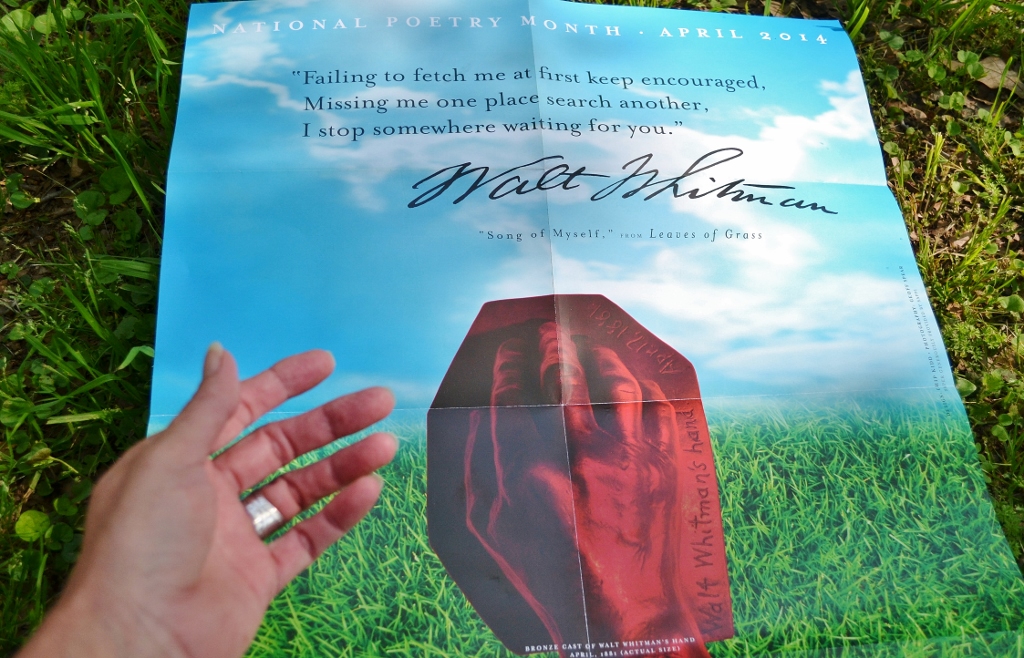
Courte$y of Academy of American Poets. Hopefully you took advantage of this freebie.
Leaves of Grass is another bit of art that can be obtained without co$t here.
Failing to fetch me at first keep encouraged,
Missing me one place search another,
I stop somewhere waiting for you.
From Walt Whitman’s “Song of Myself.”

“Ramblin’ Jack’s one of those people whose whole life was music. He’s like William Blake and Bob Dylan and other people who just believed and lived for whatever poetry they could come up with. That’s probably the thing I was trying to be.”
“Ramblin’ Jack’s one of those people whose whole life was music. He’s like William Blake and Bob Dylan and other people who just believed and lived for whatever poetry they could come up with. That’s probably the thing I was trying to be.”
Maybe you’ve never heard of Ramblin’ Jack but surely you’ll recognize the man who I just parroted. He’s not just any old poet/songwriter/singer/actor/ Rhodes Scholar he is the most interesting creature in the universe! That’s right, the above quote is from Kris Kristofferson and he totally kicks the Dos Equis man’s arse- hands down. And I love Dos Equis.
He traded a Rhodes scholarship and made his own roads. Some might argue he wasted his gifts but I believe he chose a path that allowed him to share those gifts with the world. How many stuffy ole geniuses does the world need anyway?
It’s still NPM so I’ll try not to turn this into the life and times of Kris Kristofferson. It would take years to cover that. We could talk for a month of Sundays about his material alone. Speaking of Sundays here is what I still refer to as Sunday Morning Sidewalk.
Well I woke up Sunday morning,
With no way to hold my head that didn’t hurt.
And the beer I had for breakfast wasn’t bad,
So I had one more for dessert.
Then I fumbled through my closet for my clothes,
And found my cleanest dirty shirt.
An’ I shaved my face and combed my hair,
An’ stumbled down the stairs to meet the day.
I’d smoked my brain the night before,
On cigarettes and songs I’d been pickin’.
But I lit my first and watched a small kid,
Cussin’ at a can that he was kicking.
Then I crossed the empty street,
‘n caught the Sunday smell of someone fryin’ chicken.
And it took me back to somethin’,
That I’d lost somehow, somewhere along the way.
On the Sunday morning sidewalk,
Wishing, Lord, that I was stoned.
‘Cos there’s something in a Sunday,
Makes a body feel alone.
And there’s nothin’ short of dyin’
Half as lonesome as the sound,
On the sleepin’ city sidewalks:
Sunday mornin’ comin’ down.
In the park I saw a daddy,
With a laughin’ little girl who he was swingin’.
And I stopped beside a Sunday school,
And listened to the song they were singin’.
Then I headed back for home,
And somewhere far away a lonely bell was ringin’.
And it echoed through the canyons,
Like the disappearing dreams of yesterday.
On the Sunday morning sidewalk,
Wishing, Lord, that I was stoned.
‘Cos there’s something in a Sunday,
Makes a body feel alone.
And there’s nothin’ short of dyin’,
Half as lonesome as the sound,
On the sleepin’ city sidewalks:
Sunday mornin’ comin’ down.
I left off in the last post asking who the heck was Milton and I start this one with the imagined sting of Mrs. Johnson’s ruler. You see I’ve always been a daydreamer and Mrs. Johnson was a nightmare.
I’m sure we have all had one or two (or fifteen) teachers who fed on tender brains we didn’t absolutely love. And who left us with more questions than answers such as:
Does writing sentences as a punishment really improve academic outcomes? To that I answer, NO Mrs. Johnson. No it does not. Writing I’m sorry I daydreamed through Paradise Lost did not improve my retention.
Is John Milton still relevant today? I say sure he is and I would go so far as to recommend we all take the time to study him again. Minus the rulers and redundant sentences.
And lastly, How do literature teachers live to be one thousand years old?
Because they are brain eating zombies! I don’t have a clue.
We’re not going to delve into Paradise Lost but you can get a free e-pub download from Gutenberg and read it at your leisure. Or try the online searchable version with modernized spelling.
Since May is less than a week away I chose this one. Don’t critique the spelling – all I did was copy and paste. Hey I did learn something from writing sentences as punishment.
by John Milton
Now the bright morning Star, Dayes harbinger,
Comes dancing from the East, and leads with her
The Flowry May, who from her green lap throws
The yellow Cowslip, and the pale Primrose.
Hail bounteous May that dost inspire
Mirth and youth, and warm desire,
Woods and Groves, are of thy dressing,
Hill and Dale, doth boast thy blessing.
Thus we salute thee with our early Song,
And welcom thee, and wish thee long.


 The Real Janna Hill in